
As part of an internationalization strategy, companies can choose from several pathways: direct export, strategic partnerships, distribution networks, e-commerce, external growth, or creation of a subsidiary in Canada. Each of these approaches has its own advantages and challenges, which must be carefully assessed in light of your objectives, available resources, and development timeline.
Among these options, establishing a subsidiary in Canada represents a significant commitment—one that offers numerous medium and long-term benefits.
Foreign companies entering Canada typically choose between three options: incorporating a subsidiary, starting with part-time business development, or hiring through an Employer of Record without setting up a local entity. The comparison below outlines the key differences depending on your stage and objectives.
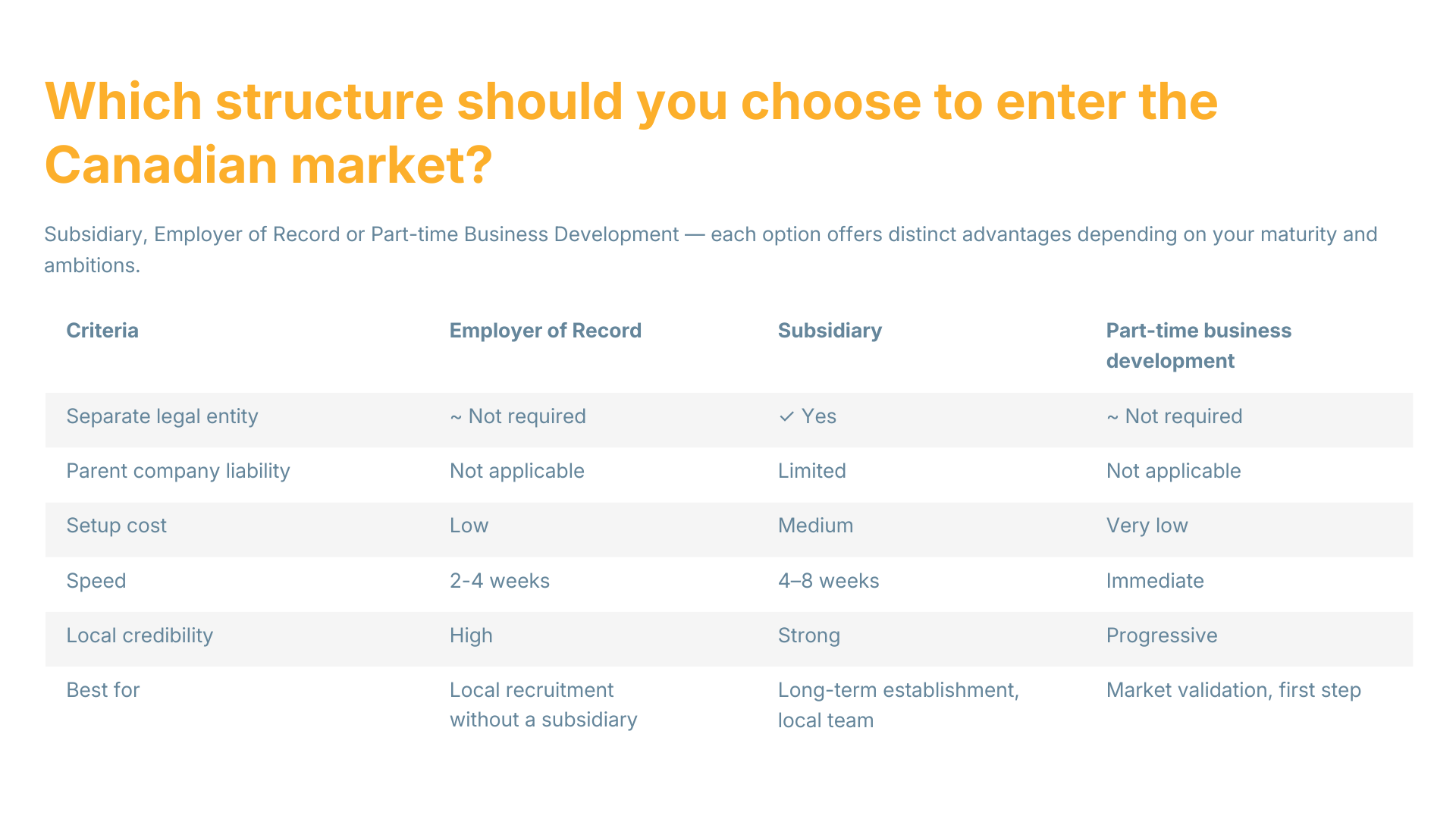
Establishing a company under Canadian law involves completing a number of administrative formalities, which differ depending on local legislation.
These formalities vary based on several factors, including the province where the head office will be located, whether the company charter is federal or provincial, the legal or civil status of shareholders, the legal structure of the company, the type of business activities, and more.
Creating a subsidiary means establishing an independent legal entity in Canada that is partially or wholly owned by the parent company. This structure allows a business to operate locally while maintaining strategic continuity with its home office.
At Adexia, we support our clients at every stage of the process to simplify these complex procedures and ensure a secure and successful market entry. Discover our international business support services
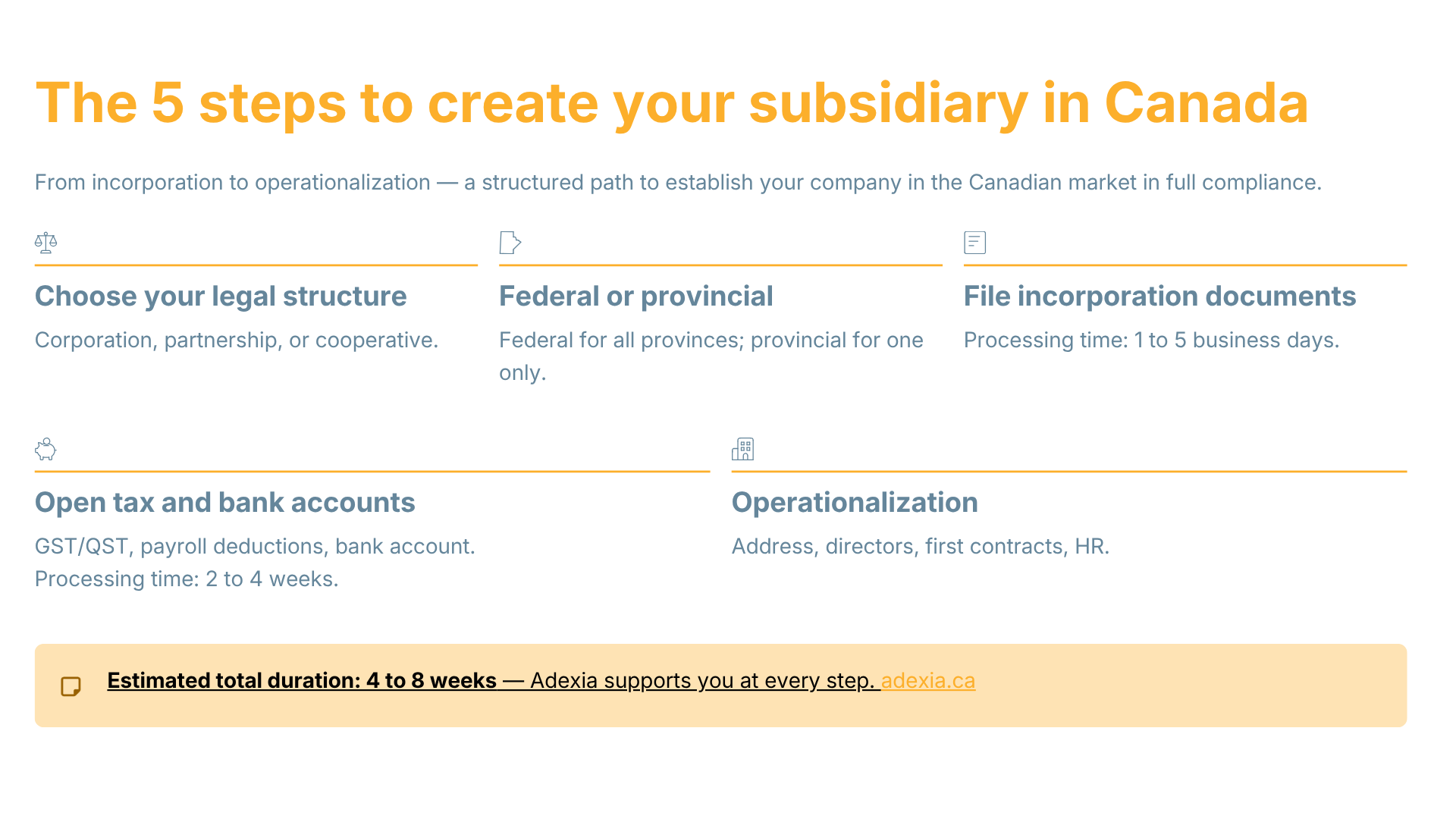
Federal incorporation gives you the right to operate across all Canadian provinces and projects a national identity. Provincial incorporation can be simpler and less costly if your operations are concentrated in one region. In both cases, some provinces — including Quebec, Ontario and British Columbia — have no residency requirement for directors, which makes setup easier for foreign companies
A subsidiary operates within its own local framework, allowing for agile decision-making and operations tailored to the realities of the Canadian market.
Localize your commercial contracts and the employment contracts of your Canadian teams by carrying them through your subsidiary.
Depending on the structure chosen, certain provincial or federal tax incentives may be available, offering financial advantages for foreign companies.
Develop your company’s Canadian and North American identity. A physical presence fosters the confidence of Canadian partners, customers and institutions
Which legal form to choose? Under which legal charter?
How to organize the shareholder package, which directors to appoint, choosing your tax year, the importance of the company’s physical address When to open tax accounts.
Every decision has consequences in the short to medium term, and some changes can be lengthy and costly.
While legally incorporating a subsidiary is quick and easy, you’ll need to familiarize yourself with the administrative ecosystem of the various levels of government. Each province has its own administrative and tax structure, so it’s essential to surround yourself with the right experts to avoid errors or omissions.
A number of experts contribute to the operation of the subsidiary throughout its useful life. Lawyers, accountants, tax specialists, personal or risk insurance brokers, landlords, immigration or mobility consultants…
A scrupulous initial selection of your experts enables you to make them partners in the success of your local establishment.
To guide you efficiently, Adexia has developed a One-Stop-Shop offer, designed to lighten and accelerate all phases of your subsidiary creation project. Explore our One-Stop-Shop offer:
At Adexia, our One-Stop-Shop service is designed to provide clients with personnalized, seamless, end-to-end support throughout the entire process of setting up a subsidiary in Canada.
Here’s what it includes:
From legal incorporation and business registration to office address setup and employee hosting, we take care of every administrative detail.
We handle essential operations such as HR, payroll, tax compliance, and executive coaching, so you can focus on growing your business.
Benefit from our established network of local experts, lawyers, accountants, and business partners across Canada.
🎯 Our mission: To allow you to concentrate on your commercial development, while we ensure a smooth operational launch.
🎥 Watch the video testimonial from one of our clients who successfully created a Canadian subsidiary with Adexia.
Establishing a subsidiary in Canada is a strategic and transformative step for any company aiming to build a lasting presence in North America. When approached with structure and the right support, it becomes a powerful growth lever.
At Adexia, we provide:
How long does it take to set up a subsidiary in Canada?
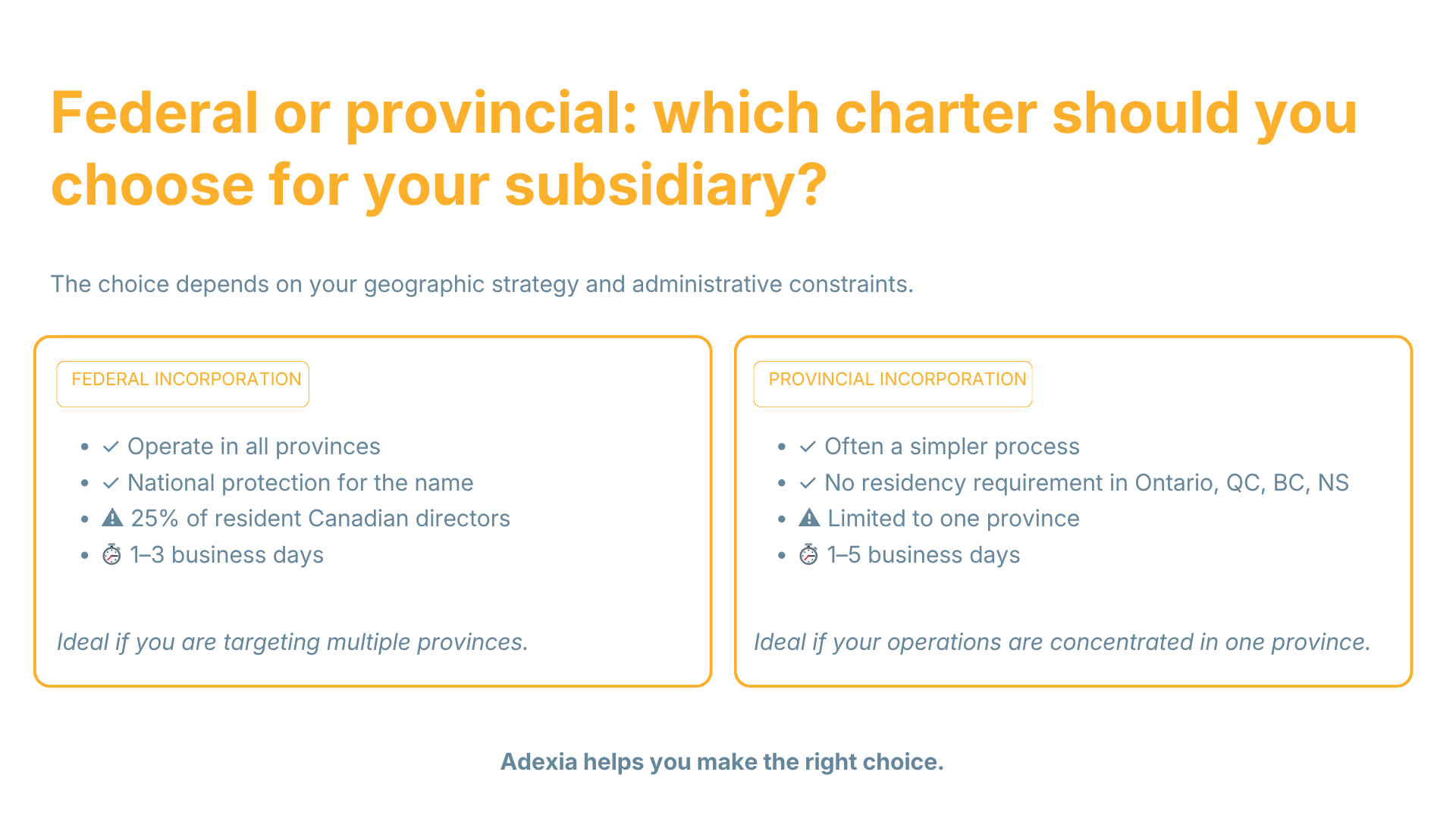
Federal or provincial incorporation takes 1 to 5 business days. The full setup — tax accounts, registered address, banking and operational readiness — typically takes 4 to 8 weeks.
Do I need a Canadian resident as a director?
For federal incorporation, at least 25% of directors must be Canadian residents. However, Ontario, Quebec, British Columbia and Nova Scotia have no residency requirement for directors.
What is the difference between a branch and a subsidiary in Canada?
A branch is a direct extension of the foreign parent — no separate legal entity, the parent bears full liability. A subsidiary is an independent Canadian entity that limits the parent’s exposure and builds stronger local credibility.
Which province should I incorporate in?
Ontario and Quebec are the most common choices for European companies. Federal incorporation gives you the right to operate across all provinces. The best choice depends on your sector, target clients and operational base.

For a foreign company looking to grow its business in Canada, building a local presence ...

The Canadian cosmetics market consistently attracts the attention of European brands looking to expand internationally. ...

Alcohol trade regulation in Canada falls under provincial jurisdiction. Each province controls importation, distribution and, ...

SMEs and Mid-Sized Companies: Have You Considered External Growth to Accelerate Your Expansion in Canada ...

Canada is Opening the Door to Strategic Investment in Energy, Infrastructure and Critical Resources Thanks ...

In today’s global landscape, where medical innovation and access to strategic markets are critical challenges, ...