
Canadian engineering is entering a pivotal decade: rarely has the country mobilized so much public and private capital to transform its transportation networks, modernize its energy infrastructure, and digitize its critical assets.
Driven by the federal Invest in Canada plan (180 billion CAD over twelve years) and record funding envelopes in Quebec (164 billion CAD in the PQI 2025-2035) as well as in Ontario (more than 200 billion CAD for the Building Ontario program), the national engineering services market reached 43.3 billion CAD in revenue in 2023, marking an annual growth of 9%.
This momentum takes place in a context of accelerated climate transition, demographic pressures, and post-pandemic resilience. The net-zero 2050 target, increasing demand for clean energy, and partial reshoring of supply chains are pushing governments and project owners to multiply megaprojects.
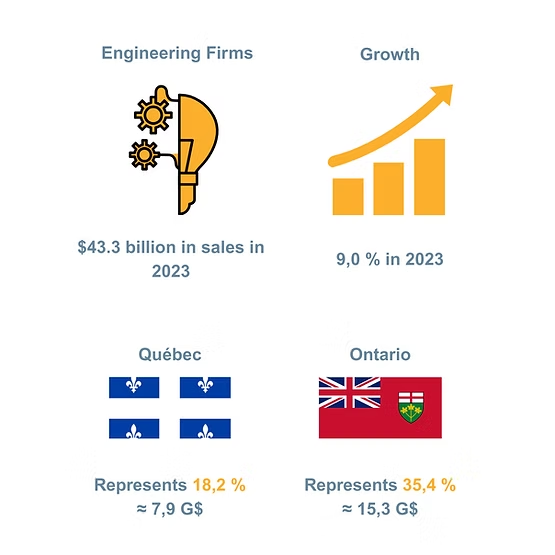
Launched in 2016, the Invest in Canada Plan injects 180 billion CAD over 12 years across five pillars: public transit, green infrastructure, social infrastructure, trade & transportation, and rural & northern development. As of March 31, 2025, 92% of the 100,000 projects are completed or underway, mobilizing 157 billion CAD in federal credits and nearly twice that amount in provincial and private contributions.
Although the Invest in Canada Plan is nearing completion (92% of the 180 billion CAD already committed), the federal government is preparing the next phase with several new programs announced in the 2024 Budget, including:
To amplify leverage, the Canada Infrastructure Bank (CIB) focuses on P3 structures: 15.8 billion CAD in signed investments covering green transportation, high-speed internet, clean energy, and community infrastructure, targeting a 3:1 leverage ratio. In 2024-25, 63 projects are under construction and 5 have already been delivered.
Beyond financing, Ottawa is strengthening ESG requirements: a mandatory climate lens on federal projects over 10 million CAD, carbon disclosure, and consultation with Indigenous Nations starting at the conceptual phase. Accelerated assessment protocols (FAST-41, Impact Act 2019) aim to reduce approval times by 12 to 24 months without compromising environmental rigor.
Finally, the economic outlook remains cautious: real GDP in Q1 2025 is expected to grow approximately 1.5% annualized, but the Bank of Canada highlights vulnerability to US-Canada tariff tensions, which fuels volatility in private projects and reinforces the counter-cyclical role of public spending.
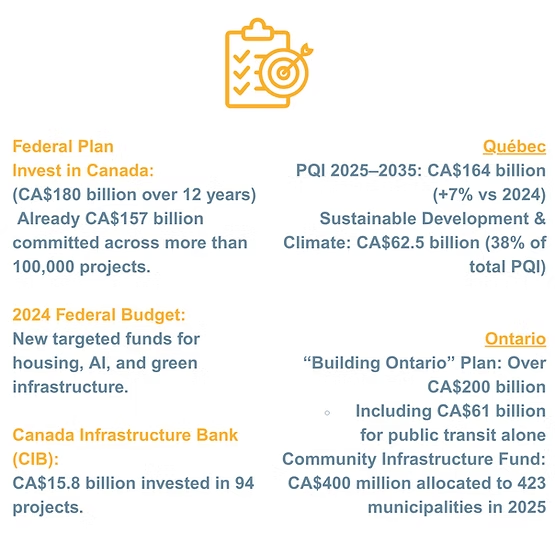
In 2023, engineering firms in Canada generated 43.3 billion CAD in sales, representing 9% growth for the year and an average of 7% annually since 2020. They report a net margin (profit after costs) of approximately 10.8%.
Estimated growth for 2023–2024: not yet officially published, but based on sector trends, an estimated increase of 5 to 7%, driven by the energy, transportation, and public infrastructure sectors.
Revenue is distributed as follows:
The engineering sector is experiencing strong demand, with a vacancy rate of 4.7% (vs 3.2% across all sectors) and an average salary for senior civil engineers exceeding 131,000 CAD per year, up 6% year-over-year. As of March 2025, the vacancy rate in “science and engineering” stood at 3.1% (vs 2.8% across all sectors).
In Quebec, the Order of Engineers projects 51,300 net new positions to fill by 2030 (+47%), especially in computer and civil engineering, with an estimated gap of 1.6%. Even with a potential increase in university graduates (≈10,000/year), the local supply will cover less than half of future needs. By 2033, 141,200 positions will need to be filled, while 89,300 engineers and construction professionals are expected to retire, creating a potential shortfall of 35,500 workers. The most acute shortages are in civil engineering (transport, roadwork), electrical engineering (SMR, grids), and P3 project management.
To address these needs, Quebec relies on fiscal incentives (30% tax credit) and language integration programs to attract foreign talent.
In Ontario, the economic immigration quota (OINP) was raised to 18,361 nominations in 2025 (+42%), targeting civil, electrical, and nuclear engineers. Fast-tracked recognition of foreign credentials through Professional Engineers Ontario, as well as mentorship and webinar programs, aim to speed up integration. At the same time, education-industry partnerships (co-op programs, BIM/SMR certifications), wage subsidies (up to 25% for young engineers), and R&D tax credits support recruitment. Diversity initiatives such as the “30 by 30” program and regional mentoring complete the set of measures aimed at filling the 35,500 critical positions by 2033.
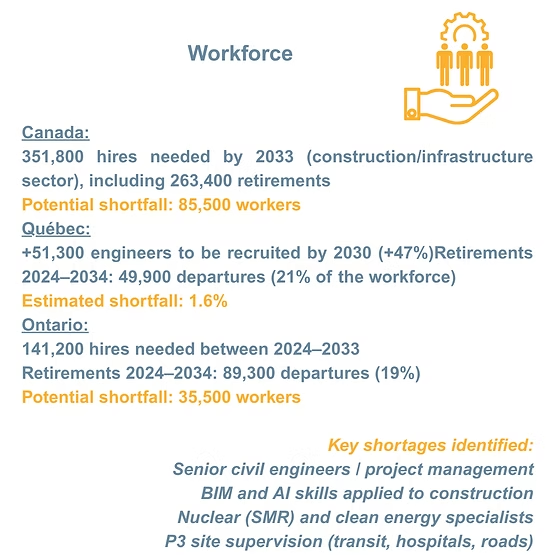
A workforce projection conducted for the Ordre des ingénieurs du Québec in 2021, and updated in 2023, is available here: https://www.oiq.qc.ca/grands-dossiers/profession-ingenieur-daujourdhui-et-de-demain-2/
These studies provide a general sense of how the engineering workforce may evolve in response to socio-economic trends. Naturally, the projections are sensitive to the initial assumptions. For example, the battery sector is developing somewhat more slowly than expected, and the forecasts did not take into account Hydro-Québec’s 2035 Plan, which was announced after the study was completed. These factors—and many others—continue to influence the evolution of supply and demand in the engineering sector.
The 2025–2035 Québec Infrastructure Plan (PQI) reaches a historic milestone of 164 billion CAD, an increase of 11 billion CAD compared to the 2024 edition. Maintaining the condition of public infrastructure remains a top priority, with 96.7 billion CAD (65% of total investments) allocated to preserving the long-term durability of public assets.
Summary Table of Major Projects and Allocations – PQI 2025–2035
Sector | Total Investment 2025–2035 | Main Projects / Areas of Focus |
Health & Social Services | 4.6 B$ | Construction, renovation, and expansion of hospitals; conversion of CHSLDs into Seniors’ Homes and alternatives (MDAA) |
Education | 3.8 B$ | Renovation and expansion of primary and secondary schools and vocational training centers |
Public Transit | 14.5 B$ | Maintenance and enhancement of networks (e.g., contributions to major transit projects via the Société de financement des infrastructures locales) |
Road Network | 35.9 B$ | Various highways and roadworks |
Project | Amount | Timeline | Delivery Model |
Saguenay Wind Farm – 3,000 MW | 9 B$ | 2024–2030 | Hydro-Québec partnership with Atikamekw and Pekuakamiulnuatsh communities |
Québec Bridge Rehabilitation | 1 B$ | 2025–2050 | Federal-Provincial agreement (40 M$/year) |
REM de l’Est (review phase) | 9–11 B$ | Feasibility study in 2025 | CDPQ Infra (P3) |
Engineers must be members of the Ordre des ingénieurs du Québec (OIQ) to sign off on plans, and all public or private projects subject to the Building Code must be backed by an engineer-approved plan. Environmental impact assessments are governed by the Environment Quality Act, with possible public hearings by the BAPE (Bureau d’audiences publiques sur l’environnement) for large-scale projects.
Since 2024, public tenders exceeding 10 million CAD must include a carbon calculator aligned with the “Carbon Analysis Framework,” and projects must propose emission reduction measures. Developers are also required to consult Indigenous communities if projects are located on traditional territories.
As of January 2024, all public projects over 100 million CAD must meet BIM Level 2 standards, and CSA standards are required for structural, electrical, and fire safety specifications.
In terms of credential recognition, Québec is a party to the Washington Accord and CETA to facilitate access for foreign graduates, but remains strict on academic records, supervised work experience (EIT), and French language proficiency. Disparities between provinces persist despite harmonization efforts.
Sector | Total Investment (2025–2034/35) | Main Projects / Focus Areas |
Public Transit | 60.7 B$ | Ontario Line (Toronto), Eglinton Crosstown West Extension, GO Expansion, TTC and Metrolinx fleet modernization |
Provincial Highways | 29.9 B$ | Highway 413, Widening of Highways 401 & 400, Bradford Bypass, Maintenance of heavily used roads |
Hospitals | 54.1 B$ | Stevenson Memorial Hospital, Peel Memorial Hospital Phase 2, New Civic Campus for Ottawa Hospital, Major regional upgrades |
Education | 30.1 B$ | Construction and renovation of schools, university and college expansions, campus digital upgrades |
Other Sectors | 48.4 B$ | Courthouses, prisons, youth services, childcare, rural water and sanitation, broadband, EV charging infrastructure |
Nuclear Waste (DGR) | 4.5 B$ (construction) × 175 years = ~26 B$ total | Deep Geological Repository for radioactive waste. A 4.5 B$ construction contract awarded to Kiewit-WSP-Hatch consortium |
Project | Amount | Delivery | 2025 Status |
Ontario Line (Toronto) | 27.2 B$ | 2031 | DBFOM contracts awarded, Pape tunnel launch in 2024 |
Darlington SMR Unit 1 | 6.1 B$ | 2029–2030 | Construction site launch May 2025 |
Gordie Howe International Bridge | 6.4 B$ | September 2025 | 85% completed |
Bradford Bypass | n/a | 2030 | Western section contract Oct. 2024 – work begins in 2025 |
East Harbour Transit Hub | n/a | 2029 | Construction contract March 2025 |
Peel & Stevenson Hospitals | n/a | 2030 | RFP issued in 2025 |
Professional Engineers Ontario (PEO) oversees the P.Eng. licensing process and continuing education for engineers. Foreign-trained candidates must follow a “bridging” process to become EITs and eventually P.Eng.
Large public and private projects must undergo an Environmental Assessment under Ontario’s Environmental Assessment Act, supervised by the Ministry of the Environment,
Conservation and Parks. Since 2023, any project over 50 million CAD funded by Infrastructure Ontario must include a “carbon budget” per the Climate Change Impact Assessment, and Toronto’s Green Development Standard applies to major public buildings to reduce carbon footprints.
Developers must consult Indigenous communities when cultural or territorial issues are involved, and all P3 tenders include a section on Indigenous engagement.
As of January 2025, all public projects over 100 million CAD must use BIM Level 2 in compliance with ISO 19650 and adhere to the Ontario Building Code and Canadian Electrical Code.
Regarding engineer mobility, PEO collaborates with Engineers Canada to streamline foreign credential recognition (Washington Accord, CETA) and reduce redundant provincial requirements, though differences persist regarding required experience and ethics exams.
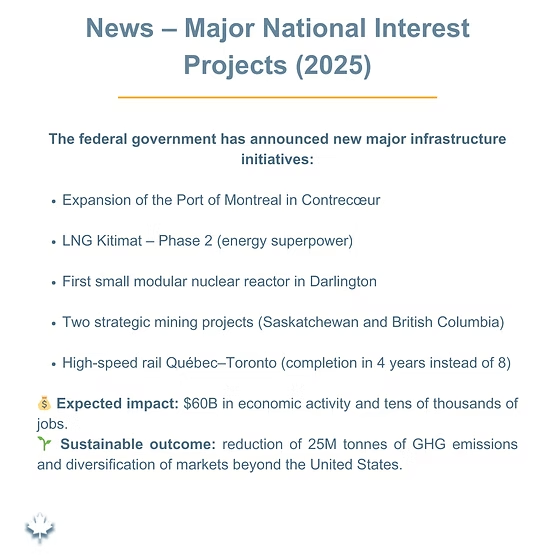
Canada is currently experiencing an exceptional infrastructure development boom. Between 2024 and 2034, 132 projects are planned or underway across the country, with a projected value exceeding 254 billion CAD in British Columbia alone. This massive wave of investment spans the transport, energy, green technology, and public utility sectors, aligned with federal and provincial priorities to support economic growth, energy transition, and climate resilience.
These megaprojects highlight strong momentum in other provinces as well: clean energy in B.C. (Site C, Coastal GasLink), rapid transit in Alberta (Hyperloop, Green Line), strategic highway upgrades in the Prairies (Regina Bypass), and large-scale carbon capture and storage programs. The scale of these projects (up to 22 billion CAD for a single project) and their geographic spread underscore the vast opportunities in engineering beyond the traditional hubs of Québec and Ontario.
Province | Project | Estimated Value |
British Columbia | Site C Dam (hydroelectric, Peace River) | 16 B$ |
Coastal GasLink (natural gas pipeline to Kitimat) | > 6 B$ (670 km) | |
Fraser River Tunnel Project (Vancouver) | ~ 4 B$ | |
Arbutus–UBC SkyTrain Extension (Vancouver) | ~ 3.3 B$ | |
Alberta | Calgary–Edmonton “TransPod” Hyperloop / high-speed rail | 22.5 B$ |
Pathways CCS – carbon capture & storage | 1.65 B$ | |
Polaris CCS / Atlas CCS (Captus Generation) | 10 B$ | |
Green Line LRT (Calgary) – 46 km, phased project | n/a | |
Saskatchewan | Regina Bypass (P3 highway bypass) | 1.88 B$ |
Québec–Ontario Corridor | Alto – High-Speed Rail (Toronto ↔ Québec) | 3.9 B$ (design phase) Design led by Cadence Consortium: CDPQ Infra, AtkinsRéalis (formerly SNC-Lavalin), SYSTRA Canada, Keolis, SNCF Voyageurs, Air Canada. |
These firms complement the existing European ecosystem of engineering and infrastructure operators active in Canada. Each brings specific expertise—civil engineering, public works, energy, signaling, water, waste, automation—underscoring the strong European presence in modernizing Canadian infrastructure.
A notable example is the Cadence Consortium, led by CDPQ Infra with contributions from SYSTRA, SNCF Voyageurs, and Keolis, representing transatlantic collaboration on the Québec–Toronto high-speed train project.


For a foreign company looking to grow its business in Canada, building a local presence ...

The Canadian cosmetics market consistently attracts the attention of European brands looking to expand internationally. ...

Alcohol trade regulation in Canada falls under provincial jurisdiction. Each province controls importation, distribution and, ...

SMEs and Mid-Sized Companies: Have You Considered External Growth to Accelerate Your Expansion in Canada ...

Canada is Opening the Door to Strategic Investment in Energy, Infrastructure and Critical Resources Thanks ...

In today’s global landscape, where medical innovation and access to strategic markets are critical challenges, ...