
Ontario, for its part, also sees the dominance of dairy products with revenues amounting to $2.5 billion. This sector is closely followed by vegetable production ($2.4 billion) and soybean production ($2.1 billion). As in Quebec, the dairy and poultry industries (eggs, chickens, turkey) are also governed by the Supply Management system, which allows producers to benefit from stable remuneration and import controls, thus guaranteeing protection against fluctuations in the international market.
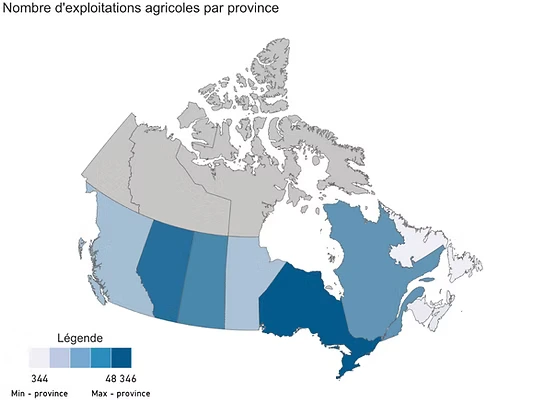
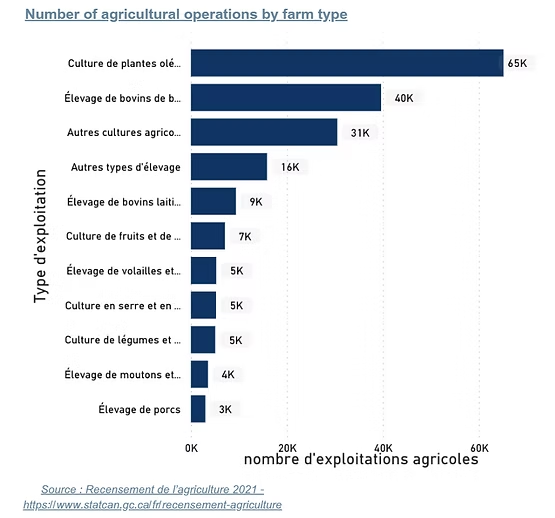
These two provinces, thanks to their regulatory structures and resources, contribute significantly to Canadian primary agriculture, which includes nearly 190,000 farms on 62.2 million hectares, representing 6.2% of Canada’s territory. The average farm size has nearly doubled over the past 50 years, highlighting the importance of technological advances and consolidation in the sector.
Canada is positioning itself as a leader in sustainable food production and processing. Several initiatives are being implemented to strengthen the sector’s sustainability:
Technological innovation continues to transform the agri-food sector in Canada, with a particular focus on improving efficiency and sustainability:
The 2021 study of Canadians’ attitudes toward innovative agricultural technologies revealed growing support for technologies such as biotechnology and genome editing, despite low overall awareness of these concepts. Canadians are particularly supportive of making biofuels from non-food sources, and a majority believe that cellular agriculture could contribute to long-term food security. These shifts in perceptions could facilitate the adoption of sustainable agricultural solutions in the future.
Farms in Quebec and Ontario are benefiting from positive economic prospects, supported by growing demand for local and sustainable products:
In 2023, net cash income from the Canadian agricultural sector reached a record high of $24.8 billion, up 13% from the previous year, mainly due to growth in livestock receipts. However, forecasts for 2024 indicate a 14% decrease in net cash income, which is expected to reach $21.3 billion, due to the expected decline in crop receipts and a slight increase in operating expenses. Despite these challenges, net cash income is expected to remain 28% higher than the 2018-2022 average.
The snapshot of green consumer habits in Canada highlights Canadians’ significant concern for the environment and climate change, with 80% valuing sustainable living. Approximately 70% of consumers seek out sustainably produced food, although price remains a major barrier, with 51% of respondents finding these products too expensive. Sustainable packaging is also a priority, with over 90% of Canadians concerned about its environmental impact. Additionally, 50% of consumers report purchasing more sustainable products than they did five years ago.
The 2023 survey of Canadians reveals a significant increase in concerns about food affordability, with 80% of respondents expressing concerns, a 29% increase from previous surveys. Regarding knowledge of the sector, only 50% of consumers feel well informed, while 71% are concerned about food waste. Despite these concerns, trust in Canadian farmers remains high, with 87% of respondents expressing confidence.
This snapshot of consumer perceptions of environmentally sustainable foods indicates that 70% of Canadians seek out these products, primarily based on sustainability labels. However, trust in these labels remains limited, with 75% of consumers believing they are often used for marketing purposes. While Canadians value criteria such as health, taste, and price, they want more information on labeling systems and sustainability standards to make informed purchasing choices.
Qualitative research conducted by Agriculture and Agri-Food Canada showed that both consumers and producers view sustainable agriculture as essential, although their understanding of the concept varies. Consumers struggle to identify sustainable practices, while producers point to misinformation within the sector as a barrier. The findings highlight that consumers prioritize criteria such as price and quality, and while they express interest in sustainable practices, few are willing to pay more for eco-friendly food. Furthermore, consumers living in remote communities feel limited in their choices, highlighting their reliance on local, sustainable food sources.
Source: https://agriculture.canada.ca/en/sector/consumer-behavior
Agritourism is experiencing significant growth in Quebec and Ontario, offering new economic opportunities for local producers.
Source: https://www.lesaffaires.com/dossiers/agrotourisme-miser-sur-les-produits-dici/
The food processing sector in Canada continues to transform to meet new market demands.
Despite the challenges facing Canada’s agriculture and agri-food sector, its strengths and innovations offer exceptional growth potential. Sustainability, innovation, and market diversification are essential to ensuring the long-term competitiveness of farms.
Looking ahead, several emerging trends are shaping the sector landscape: regenerative agriculture, which aims to restore soil health and biodiversity; the growing use of advanced technologies like artificial intelligence and precision farming, which optimize yields while reducing environmental impact; and a growing demand for sustainably and ethically sourced food products. These developments present not only challenges but also unprecedented opportunities for entrepreneurs looking to establish a foothold in the Canadian market.
The year 2025 not only reveals the structural weaknesses of the Canadian agricultural model, but also offers a unique window of strategic opportunity. In light of the challenges identified in 2025 – bilateral trade war, fragile export chains, internal production pressures, changing food preferences – the Canadian agriculture and agri-food sector requires a series of strategic interventions, at federal, provincial and sectoral levels. In short, 2025 is marked by an active and pragmatic realignment of Canadian trade diplomacy, with Europe and Asia as the new economic pillars.

The Canadian food and beverage market is mature, highly competitive, and strongly intermediated. Growth is ...

Alcohol trade regulation in Canada falls under provincial jurisdiction. Each province controls importation, distribution and, ...

SMEs and Mid-Sized Companies: Have You Considered External Growth to Accelerate Your Expansion in Canada ...

Canada is Opening the Door to Strategic Investment in Energy, Infrastructure and Critical Resources Thanks ...

In today’s global landscape, where medical innovation and access to strategic markets are critical challenges, ...

Canadian engineering is entering a pivotal decade: rarely has the country mobilized so much public ...